Ananda Coomaraswamy in his second chapter takes a lot of time explaining how traditionalists view art in its historical and cultural context, whereas he recognizes that in our society today our perception of art has "evolved" into which we take into account our personal preferences and what is the better and more realistic style. Yet with his analogy of the barn and cathedral as was explained by Mr. O'Donnell, the traditional perspective on art seems to try and make art viewable through an objective lense that is free of our personal biases which prevent a fuller understanding and appreciation of it.
"Whoever believes that art "progresses" contrasts the most primitive with the most advanced (or decadent) styles of art as though the primitive had been trying to do what we try to do... So far from this, the only test of excellence in a work of art is the measure of the artist's actual success in making what was intended."
It seems as though Coomeraswamy is borrowing a concept from Michel Foucault who believed that people from different periods in time, have been unintentionally biased in their approach on how they understand and analyze cultures that are separated by time and space. These different time periods, are referred to as epitome(s). So in the 21st century, as a western society we value and celebrate the individual. Such ideas originated in the Renaissance and Humanistic movement in the 19th century, according to Coomeraswamy. Thus, it is hard for many individuals to fully respect the "Byzantine perspective" of medieval art and regard it on the same level of perfection as Michelangelo's David.
Sunday, October 6, 2013

Saturday, October 5, 2013
Silent Symphony
So after we watched the film on John Cage, I was curious as too the nature of this man's famous work of 4 33. I Found a video of a conductor leading a orchestra in performing this piece. And although it is 4 minutes and 33 seconds of silence, the video itself is interesting in its capturing of people's reaction to the "beauty" of the piece and the perfection of which it was perfected. Although the complexity of the piece and the talent needed to perfect such a composition is subjective to the listener, why is this piece so reputable especially in regards to his other works which express extreme amounts of experimentalism.
Although the piece is too recognize and focus on the beauty of Silence, why do people react in such a way. The people at this performance were going as fanatic as one can when going to see a symphony perform. The two gentlemen commentating that night were saying that the playing of 4 33 was the most anticipated work of the evening. Now is the reason that Cage is considered a genius because he has redefined music? Normally when we even think about a symphony or classical music we are drawn into an association with emotion or a memory. Yet what Cage is doing is to ponder the here and now in the absence of music. People are paying to see the exact opposite of what normally occurs during such an event. What exactly inspired Cage to do this? Why was this theme so important for him to convey, and how was its reception.
Was the purpose to create a symphony of silence for people to recognize the silence in their lives? Or for people to appreciate that silence? The idea of people going to see silence seems to be somewhat interesting as Im sure there are more interesting and more reflective and spiritual places to sit in silence. Maybe the reason people still draw inspiration from the music or rather the absence of it is to celebrate the genius and ideas of John Cage who found new ways of transferring ideas through music.
Although the piece is too recognize and focus on the beauty of Silence, why do people react in such a way. The people at this performance were going as fanatic as one can when going to see a symphony perform. The two gentlemen commentating that night were saying that the playing of 4 33 was the most anticipated work of the evening. Now is the reason that Cage is considered a genius because he has redefined music? Normally when we even think about a symphony or classical music we are drawn into an association with emotion or a memory. Yet what Cage is doing is to ponder the here and now in the absence of music. People are paying to see the exact opposite of what normally occurs during such an event. What exactly inspired Cage to do this? Why was this theme so important for him to convey, and how was its reception.
Was the purpose to create a symphony of silence for people to recognize the silence in their lives? Or for people to appreciate that silence? The idea of people going to see silence seems to be somewhat interesting as Im sure there are more interesting and more reflective and spiritual places to sit in silence. Maybe the reason people still draw inspiration from the music or rather the absence of it is to celebrate the genius and ideas of John Cage who found new ways of transferring ideas through music.
Authentic Works
Authentic works of art are held in higher regard than works of art that are mere copies of originals. Why? Mostly because we view it as a lack of originality, an incapability of producing ones own material, but the reason behind making a copy of an original also effects our view. If someone copies an original merely for monetary gain, or for achieving a higher status in the art community, then we tend to look down on these individuals.
In my opinion, not all copies are bad...if they are made for the right reasons. If they were made for the previous reasons listed, or similar reasons, then my view of these works is very judgmental. This might be why I view "ready-made art" as a lower form of art, if it can even be called that. Many artists pour their heart and soul into a work, and yet they are compared to works that can be grabbed off a supermarket shelf.
I do believe that there is a beauty in functionality, however it is not always on the same level as original works of art, and should maybe be regarded differently.
Comments?
In my opinion, not all copies are bad...if they are made for the right reasons. If they were made for the previous reasons listed, or similar reasons, then my view of these works is very judgmental. This might be why I view "ready-made art" as a lower form of art, if it can even be called that. Many artists pour their heart and soul into a work, and yet they are compared to works that can be grabbed off a supermarket shelf.
I do believe that there is a beauty in functionality, however it is not always on the same level as original works of art, and should maybe be regarded differently.
Comments?
Thursday, October 3, 2013
Beauty as Perfection
One concept Coomaraswamy argues for the more ancient or medieval view of art is that beauty is judged by how perfect an object it is. Another way to think about this is how close does the art get to the artists intent. Coomaraswamy uses the illustration of a barn compared to a church. A barn that is perfectly constructed is objectively no less beautiful than a perfect cathedral. The subjective view of beauty is rooted in the individual and that is where differences in opinions on beauty originates. Looking at the two examples below it's hard to disagree with Coomaraswamy's understanding


Who Cares About Authenticity Anyway?
Reading through the articles on this blog, I see people asking the question "Why does society value authenticity?" I found an article written by none other than Denis Dutton on the subject. Feel free to read it here.

Tuesday, October 1, 2013
The One and beauty
Class this morning reminded me of a lesson in a previous philosophy class. I cannot remember who the philosopher was, but it was discussing form and reality in terms of the divine. Much like was said in the lecture, it was believed that art was a connection to the divine. This philosopher described every aspect of the visual world as a connection to the divine. For example, knowing the form, shape, color of a simple object like an apple has a divine aspect to it as well as a tangible physical aspect. I thought it was interesting the connection between these two classes and it made me think about how art can be divinely inspired. True beauty seems to come from some divine intervention according to Plotinus, which makes me think, is the beauty come from our perception, or can we see the true divinity in an object.
I understand that this post is a little scatterbrained and all over the place, so what do you guys think? is true beauty divinely inspired or not? What about secular views of art? Comment below! :)
I understand that this post is a little scatterbrained and all over the place, so what do you guys think? is true beauty divinely inspired or not? What about secular views of art? Comment below! :)
Do Museums Strip the Sacred?
Does placing an object in a museum make it less sacred?
Have you ever gone into a museum and seen someone bow down to a statue of Isis, or begin the mummification process supervised by a statue of Anubis (god of mummification and the afterlife). I for one, have not.I don't believe that the object being in a museum makes not represent what it used to - it is still a depiction of a god/goddess, still a ritual mask, etc., yet it is not going to be used the way it once was meant to be.
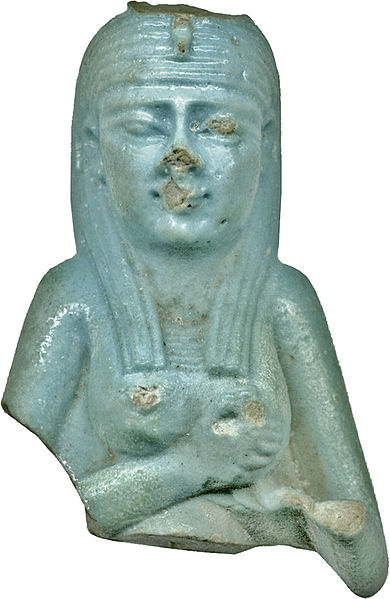 |
| Isis Nursing Horus, Walters Art Museum |
Thoughts? Comments?
Subscribe to:
Posts (Atom)